What is the right level of support for parents to give aspiring junior golfers? Photographs by...
Now that the Presidents Cup is over, what's next for Medinah?
This article appeared in the November 2026 edition of Chicago District Golfer.
To read more Chicago District Golfer stories, head to our article archive.
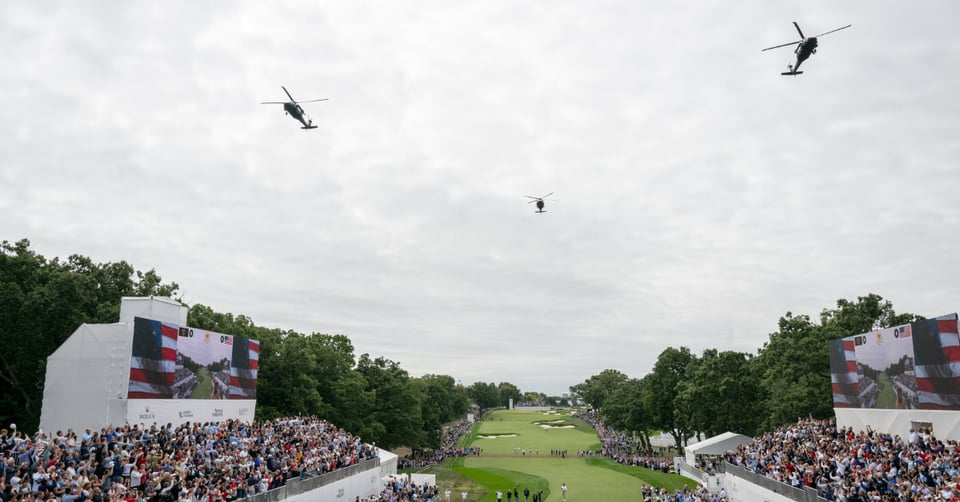
By Medinah CC/Nick Novelli
The last putt had barely reached the bottom of the cup in the Americans’ exciting 17-13 comeback victory over the International squad at the Presidents Cup when people began wondering, “Now what?”
By all accounts, Medinah Country Club and its radically reimagined Course No. 3 had passed the audition. One could almost hear the collective sigh of relief from members who’d spent more than $24 million on the redesign project that had erased much of the heavily forested classic treelined “monster” and, in turn, a good part of its tournament history. The course that had hosted multiple U.S. Opens, PGA Championships, Western Opens (including a BMW Championship) and the unforgettable 2012 Ryder Cup was gone. The mostly straight and narrow corridors that had demanded players hit their tee shots straight and far – essentially a Penal design – had been transformed into veritable six-lane highways, a Strategic design philosophy that made the course easier for everyday golfers (at least theoretically) but one that posed different challenges for the pros.
They would be faced with making more strategic decisions, dealing with more crosswinds, and, yes, that maddening Boundary Fence that comes into play on three holes on the front nine, which had some hitting 3-wood off the tee to avoid having their ball run out-of-bounds. Two “redundant” par-3s on the back nine (Nos. 13 and 17), both straight south-to-north (with the prevailing wind) shots over Lake Kadijah that were easy for the pros had been replaced with diagonal tee shots. One of them, No. 13, a short southeast-to-northwest shot not requiring a water carry, and the second, No. 17, a long northwest-to-southeast shot over the lake. Both holes were arguably more challenging because they subjected players to crosswinds from different angles. The new star of the show was the risk-reward 16th hole (No. 12 for the tournament), a diagonal par-4 over the lake that was set up short enough to challenge players to go for the green.
Perhaps the key to it all was the 40 miles of brand new unseen underground pipe that lay beneath Medinah’s rich, water-retaining black soil – great for agriculture but not for golf course drainage, where a sand base is preferred. Several inches of rain fell in advance of tournament week; in the past, that would have meant flooding on fairways 5 and 6. Now, by the time the event started on Thursday, the playing surface had mostly dried out. By the weekend, it was running firm and fast, the way everyone wanted it to. Course No. 3 had answered its first challenge.
Of course, it all comes back to the bottom-line question: Is the latest iteration of Medinah’s Course No. 3 worthy of hosting a major championship?
Kerry Haigh, chief championships officer for the PGA of America, has been the course “set-up man” for the PGA Championship and the Ryder Cup since 1993, including the 1999 and 2006 PGAs and the 2012 Ryder Cup at Medinah. He visited Medinah during Presidents Cup week and liked what he saw from the Australian architecture firm of Ogilvy, Cocking & Mead (OCM).
“I thought the course changes were significant and certainly made for more options and variety of shots for the players, particularly around the greens,” Haigh said. “We (PGA of America) were aware that the Club was going through the process of identifying architects and then reimagining the whole golf course. We were very supportive of them hosting the Presidents Cup, which appeared to be very successful, and which certainly made for a very exciting finish.”
Asked if he thought “new” Course No. 3 had proven itself as a major championship site, he commented, “Medinah has always been a worthy venue to host a Major Championship and still is today.”
Unfortunately, because the PGA Championship’s date is now in May, that event’s not coming to Medinah. A Ryder Cup, with its late September dates, is more of a possibility.
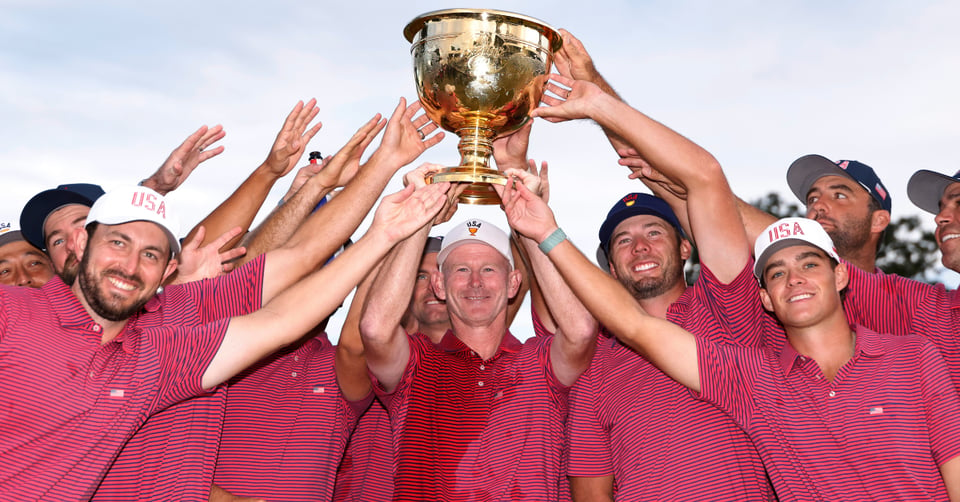 U.S. captain Brandt Snedeker and his American players raise the Presidents Cup trophy after their dramatic 17-13 comeback victory over the International team. (Michael Reaves/Getty Images)
The U.S. Open, which is played in June every year, is the American major Medinah most likely could host. Though the next open date is 2043, one never knows. Medinah got the Presidents Cup because another course had canceled. Medinah’s waiting in the wings in case the USGA needs them. Moreover, the “wide open” course could be easily adapted to USGA set-up requirements, according to Ryan Potts (pictured, bottom), a former University of Illinois golf team member who helped lead the committee that decided on OCM.
“Let’s say the USGA came in, they are the ones that really would look at altering fairway lines and width,” Potts said. “There are five holes off the top of my head where they could take a 40-yard-wide fairway and narrow it to 25 and protect par on every single one of those holes.”
The renovation has created more break in the greens, Potts added. For the Presidents Cup, the green speeds measured at 12.5 on the Stimpmeter.
“If you were to have a U.S. Open, where difficulty becomes a little bit more important, and you only cared about four [hole locations], I think you could see a completely different golf course even on the greens. We could get them to 14 (on the Stimpmeter) easily.”
USGA Chief Championships Officer John Bodenhamer said, “Congratulations to Medinah Country Club for recently hosting an exciting Presidents Cup Match. The changes to their Course No. 3 showcased nicely and provided a quality test for some of the world's best players. Medinah is well positioned to continue its wonderful history of hosting the game's elite competitions.”
Door cracked open?
Mike Cocking, one of the architects on the OCM team, said, “The course is plenty long enough (7,650 yards from the Championship tees) and there is enough interest around the greens to keep the winning score fairly low. We’d just need a nice lead into the event weatherwise…It would all just come down to how firm and fast it plays.”
Paul McGinley, an assistant captain on the 2012 European Ryder Cup team (and later captain in 2014), described Course No. 3 as “quite a stern test for players of this quality.” Now a Golf Channel commentator, McGinley said during one show, “I think this is a really long, tough, difficult golf course more akin to a U.S. Open or a major championship than it is a regular PGA Tour event.”
Speaking of the PGA Tour, the last time it had an event at Medinah was the 2019 BMW Championship as part of its FedExCup Playoffs. Justin Thomas won with a score of 25-under-par, a number that would have been unthinkable for Medinah in the era before 460 cubic centimeter driver heads and the distance-enhancing golf ball pioneered by the Titleist Pro V1 and now copied by other manufacturers. Moreover, it rained during the 2019 tournament, leading to soft fairways and greens, which freed players to “throw darts” with no fear their ball would bounce off the fairway or hit the green and ricochet into a bunker. Length? Meaningless to today’s college players, much less elite-level PGA Tour pros.
The PGA Tour owns and operates the Presidents Cup and clearly appreciates the enthusiasm of the Chicago market.
“[The Presidents Cup] was the largest build in the history of the events we operate and the highest producing,” said John Norris, executive vice president of PGA Tour Events.
“Build” translates to corporate hospitality sales, where golf tournaments make most of their money (not including TV revenue). “Producing” means revenue earned. With the PGA Tour now a for-profit organization (it used to operate as a charity), of course it likes Chicago. As previously reported by several outlets, the BMW Championship is set to return to Medinah in 2030 as part of the PGA Tour's new Championship Series, with Olympia Fields hosting the 2028 event.
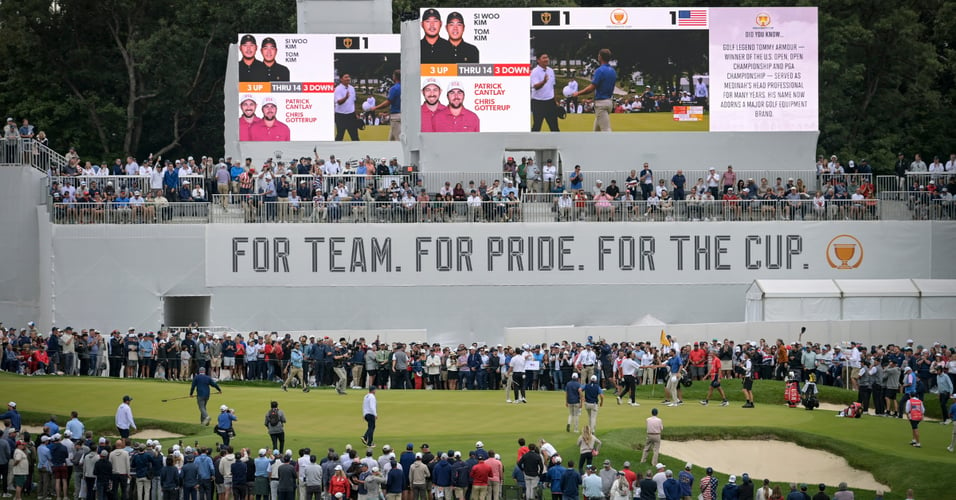 Medinah's large crowds and record hospitality sales made this year's Presidents Cup the most successful in the history of the event. (Medinah CC/Nick Novelli)
Whether it’s the U.S. Open, the BMW Championship or the Ryder Cup, Medinah club president David Latham said the club would like to host a big tournament every five to seven years. Those tournaments produce revenue for the club. But Medinah also would consider a U.S. Women’s Open, a U.S. Amateur, college events, even a high school state championship.
To that end, Latham established an Outside Play Committee and designated Potts to lead it.
“I stressed to them that you are not just looking at a professional tournament,” Latham said. “You are looking at every tournament that we could possibly have here - small, medium and large.”
As for the U.S. Open?
“I do believe that eventually they’re going to call us up and say we would like to talk to you,” Latham said. “You can’t continue to ignore this market and this club.”
Barry Cronin is the editor of Chicago District Golfer.
Medinah Says It Would Consider Hosting High School State Championships
Medinah Country Club would entertain the notion of hosting the boys and girls Illinois state high school championships on a regular basis, according to club president David Latham .
“We could do it every single year,” Latham told Chicago District Golfer from across a picnic table during the Presidents Cup. “We could do the boys and the girls at the same time. The kids and the parents would love it.”
Hosting the state championships would give Medinah a chance to open itself to the public more often.
“It would be an opportunity for Medinah to be a steward of the game,” Latham said. “We are legendary. We have an opportunity and we have a responsibility to showcase our club, give back to the game and give back to the community.”
With the tournament always being in October, when there’s far less play at the club, it would make it comparatively easy to host even though it’s held on Friday-Saturday, adding that the cost to the club would be negligible.
Some would argue that Medinah is located too far north in the state. Currently, the state championships are held in Central Illinois – the boys at three courses in Bloomington/Normal and the girls at two courses in Decatur. Latham thinks players and parents from places as far south as Alton, Quincy and Effingham would be willing to drive another couple of hours for the opportunity to play at Medinah.
“Could you imagine? You’re going to Medinah and you’re playing in the state championship, and your parents get to walk the fairways with you,” Latham said. “It’s a long trip for some of the kids from the central part of the state, but would they make it? You bet your bottom dollar they would.”
It’s likely the tournaments would be held on Course No. 1 for the boys and Course No. 2 for the girls, he said. Ever since Course No. 1 underwent a massive renovation directed by famed golf course architect Tom Doak in 2014, it has received excellent reviews. And since Medinah’s founding in the 1920s, Course No. 2 traditionally has been the women’s course, mostly because of its shorter length. No one could argue objectively that the Medinah courses wouldn’t be a far sterner challenge than those that currently host.
Illinois’ Class 3A boys championship is held annually at The Den at Fox Creek in Bloomington. In Wisconsin, high school championships regularly are played at some of the state’s top courses, such as the Meadow Valleys course at Blackwolf Run, University Ridge, Wild Rock Golf Course and Trappers Turn. In Iowa, state championships move around. This year, they were hosted by Davenport Country Club in Bettendorf, a nationally revered private club on the state’s eastern border.
But before the Chambers of Commerce in Bloomington and Decatur get angina about Medinah hosting the high schoolers, the Illinois High School Association (IHSA), which is based in Bloomington, would have to approve the change. In addition, the club’s Outside Play Committee, which Latham established to take a strategic approach to future tournaments, would have to approve the idea. Then membership gets to vote just as it did for the Presidents Cup.
—Barry Cronin