

With outstanding golf, great value and plenty of options, Gaylord is ready to give Chicago golfers...
Historic Rock Island Arsenal Golf Course is one of a kind
This article appeared in the June 2026 edition of Chicago District Golfer.
To read more Chicago District Golfer stories, head to our article archive.
Photographs by JR Howell
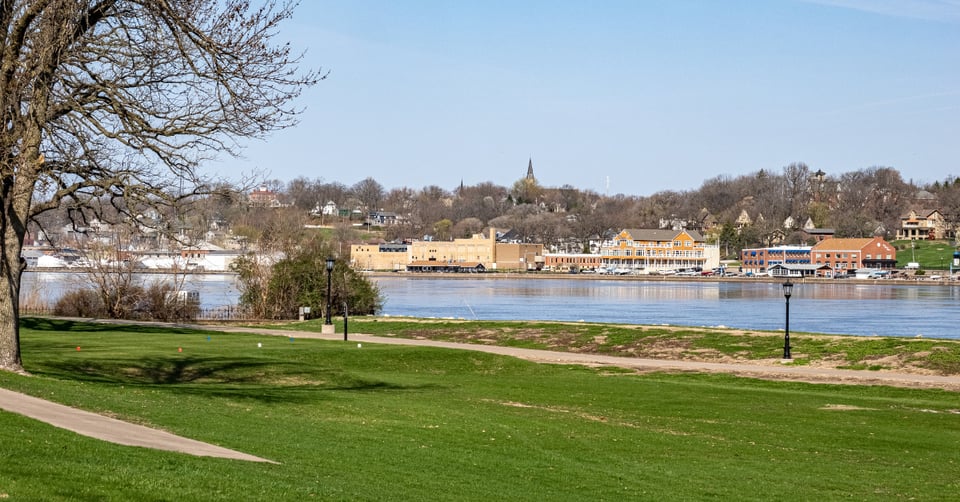
The first tee at Rock Island Arsenal Golf Course is hard against the Mississippi River with a view of the city of Davenport, Iowa.
The Rock Island Arsenal Golf Course sounds like a hoax or maybe a prank. You mean to tell me there’s a golf course on a small island in the Mississippi River and it’s been there since 1897? An actual golf course, hard against the banks of the mighty Mississippi, lies within the high- security confines of a U.S. Army arsenal? Confederate prisoners of war were housed there during the Civil War? And nearly 2,000 Confederate soldiers are buried there?
This can’t be real.
It’s real. Luckily, any hardy golfers near the Quad Cities this summer have a second chance to experience some of that history.
The original Rock Island Arsenal Golf Course (RIAGC), a delightful 18-holer, closed its doors in 2018, apparently for good. But it rose from the dead last summer, returning as a nine-hole course.
It was a nice revival for what began as five holes in 1897 and was expanded to a full 18-hole layout by 1902. William Taft, then Secretary of War, granted the Arsenal course its operating license in 1906. Taft later followed Teddy Roosevelt as U.S. President.
The Island’s military history dates to 1816, when Fort Armstrong was built to protect river shipping after the War of 1812 with Great Britain. The armory was established in the 1880s. It is a National Historic Landmark and also the U.S. Army’s only active foundry for equipment and ordnance.
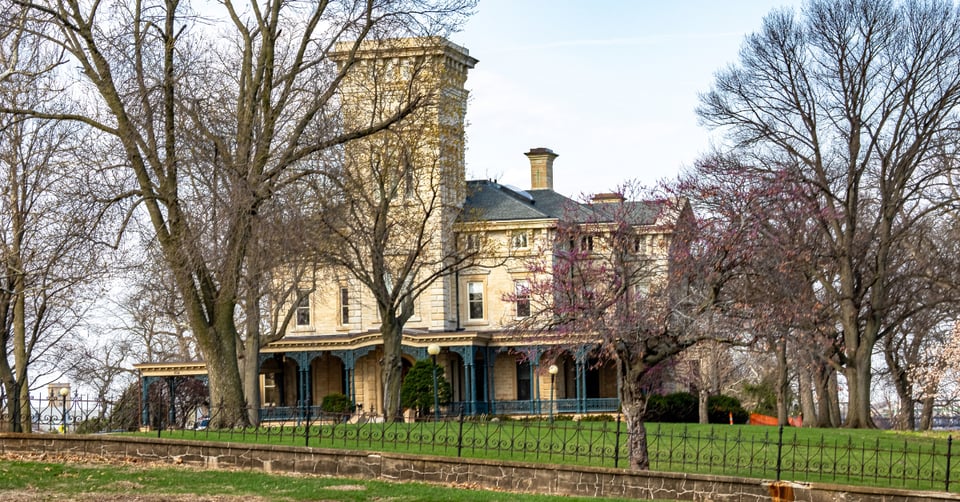 Quarters One was lived in by top officers.
Not all the history is still there. The clubhouse, circa 1906, and its once magnificent ballroom, is no longer in use and there are plans to tear it down, a reminder of the fine line between historic and just plain old.
The course’s nine surviving holes form a loop, with the first few holes running adjacent to the riverbank before looping uphill and inland. The course covers 3,028 yards and is fun and not the pushover it sounds like. Plus, it is not every day (or any other day, anywhere) you can watch steamboats pass before and/or after you hit a tee shot. It doesn’t matter that they’re tourist-carrying faux-steamboats; they’re cool.
The course is open to the public, but it wasn’t the easiest course to get on. My son, Mike, and I checked out the place last summer when it had only been open for a month after its comeback. At the Rock Island Arsenal’s gated entrance, we went inside to fill out detailed forms to get passes. I confirmed my Social Security number on a keypad, signed, had my photo taken and was given a pass valid for one year.
Mike didn’t have a Real ID. Oops. That meant he needed a second form of identification and he didn’t have one. So even if he wasn’t going to prison – just kidding – we probably weren’t making our 2:40 tee time. Luckily, he was able to retrieve the vehicle registration from his car, which we’d driven from Pittsburgh, and it was accepted.
The next problem was that we could see the golf course and we drove past several holes, but couldn’t find where we were supposed to check in. The website address directed us to the old clubhouse, which was boarded up. We saw old cannons, tanks and statues, and even a driving range, but no golf shop.
We stopped to ask a guy walking along the street, and he told us the shop was next to the museum, a few blocks away. The guy working the golf shop desk laughed about our adventure. He gave us the $20 twilight rate for unlimited golf as a nice make-up call since he didn’t find our tee time, which wasn’t logged because the website wasn’t working so great.
More adventure. There was no sign of the first hole or any signs to the first hole. Well, a dotted line painted on a sidewalk across the street had to be there for a reason, so we followed four blocks to the river and there, finally, was the aforementioned scenic first tee.
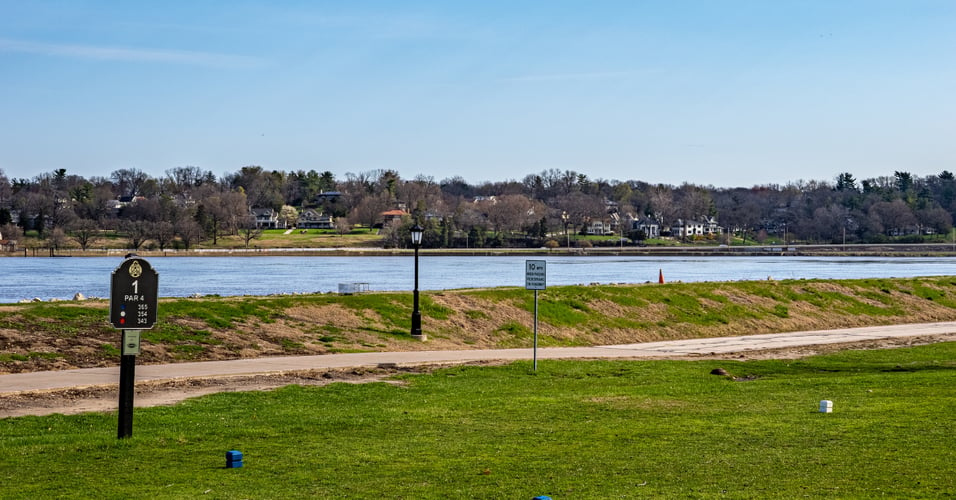 Another view across the Mississippi River from the first tee.
The first hole was a breather (a common refrain on this track), just 365 yards and slightly downhill. Mike hit a big drive just o the edge of the green. He earned a Korn Ferry Tour (KFT) card a few times, and he can launch a ball. It wasn’t that much of a breather for the others in the group – that would be me.
I’d pick the par-5 second hole as my favorite. A raised road crossed the fairway somewhere in the landing area – well, my landing area. The hole was 513 yards and just a driver-gap wedge for Mike, whose driver easily flew the road. My weak drive stopped on the banked upslope inches short of the road. Then I visited some trees in the right rough near the green. I might’ve made a par, or not. Things got blurry. Still, I never played a hole that looked like that one.
Old-timers playing at RIAGC should still recognize some holes. The first three holes are very close to the original course’s first three holes, and the last six holes are basically Nos. 13-18 from the original course. The other 12 would be listed by the Army as MIA (missing in action). Well, casualties happen.
The “Most Snakelike Hole” was No. 6, a 508-yard par 5 that sloped downhill toward the river. The fairway went one direction, then veered back the other way and had a surprise down near the green, a small pond hidden from view. Consider yourself warned.
The “Most Intimidating Hole” was No. 7, a par 3 playing 240 yards from the blue tees AND the white tees. That’s a long par 3 for me. Mike hit an iron; I hit a fairway wood. One of us made a par. One of us made a double. Solve that puzzle if you can.
The ninth hole was a pleasant finish – wide open, 373 yards, with a view of the downtown buildings. Its green was adjacent to the driving range, still three blocks from the golf shop.
That was just a minor inconvenience for the privilege of being able to say we played golf on the Mississippi River. We didn’t make history, but we experienced it.
Gary Van Sickle has covered golf since 1980 for the Milwaukee Journal, Golf World and Sports Illustrated.